
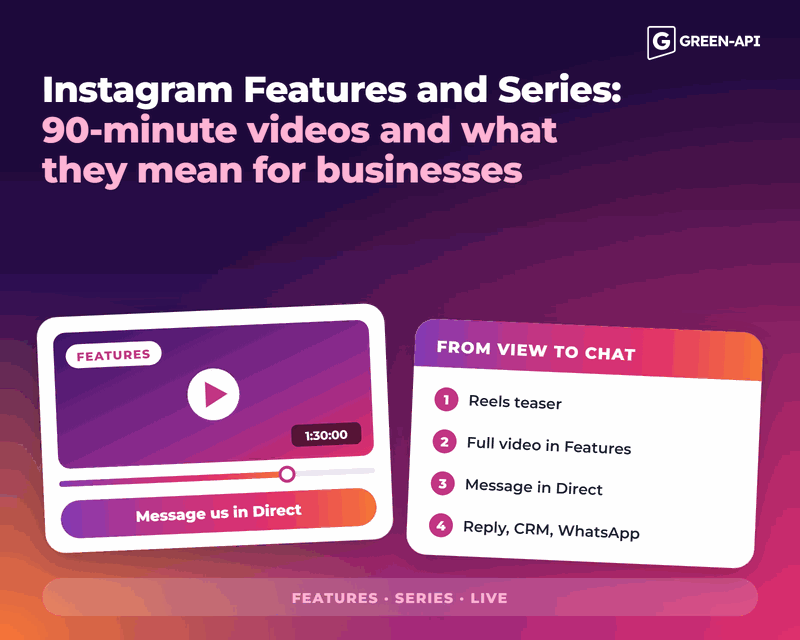
What Instagram announced
Instagram head Adam Mosseri and VP of Product Tessa Lyons presented the changes on October 26, 2026, in a video posted on Instagram. “It’s early, and we’re testing and listening to feedback as we go,” Mosseri wrote in the caption.
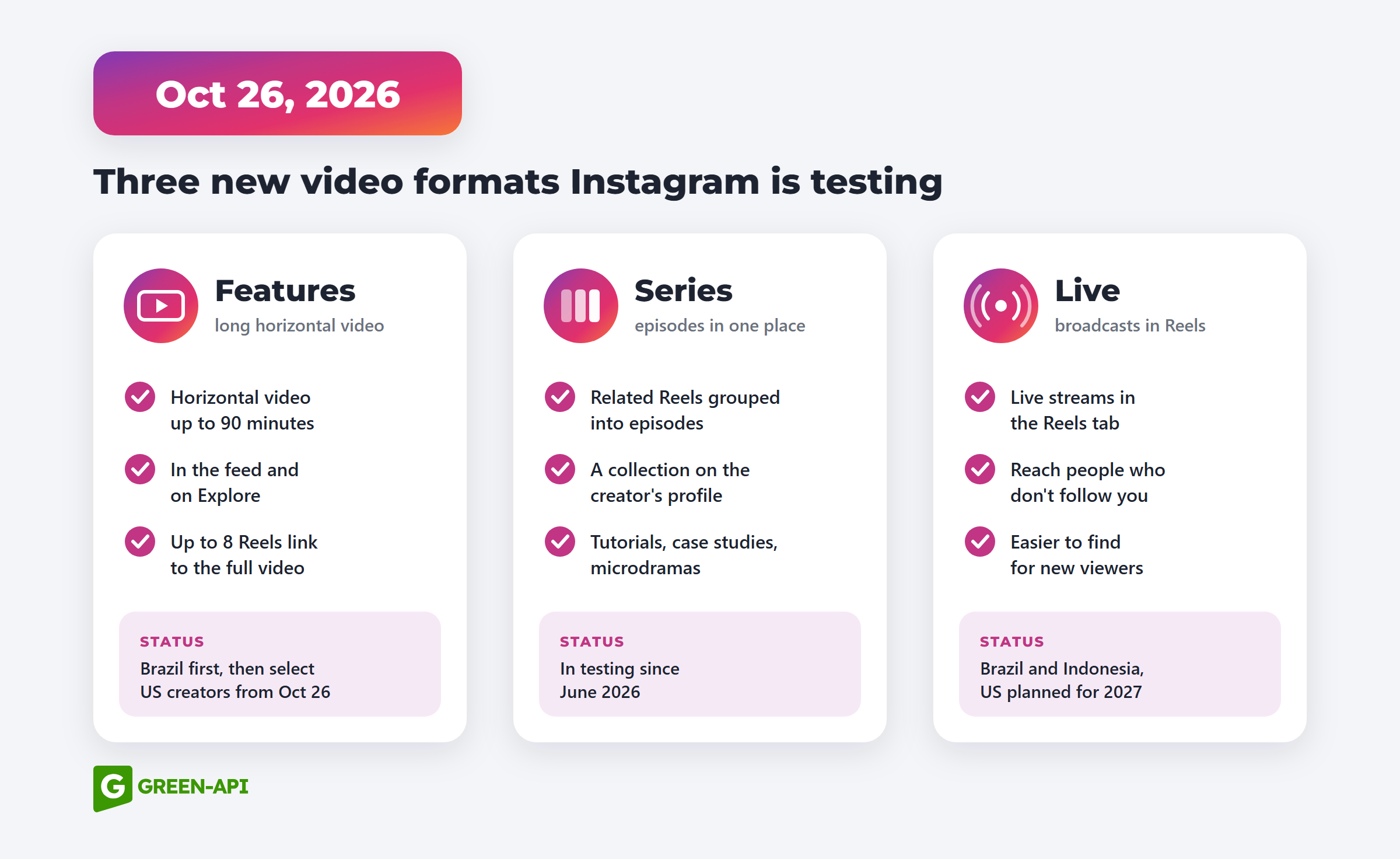
Features. These are horizontal videos up to 90 minutes long that appear in the feed and on the Explore page. Instagram tested the format with creators in Brazil first. On October 26, it started a rollout to select creators in the US, with plans to expand in the coming months. In a test feature called Clips as Reels, a creator can connect as many as eight Reels to one long video. A viewer taps the teaser and moves to the full video without leaving the app.
Series. Creators can group related Reels into an episodic collection with its own tab on their profile. A viewer who finds an episode in the feed or the Reels tab can tap through to the full series and watch the other episodes in order. The format fits serialized content, including microdramas: short scripted shows split into one-minute episodes. Instagram has tested Series since June 2026. According to Dexerto, the company plans to bring the test to the US in late 2026 or early 2027. Separately, Social Media Today reports that Instagram removed the option to link Reels to each other on October 28, 2026, to simplify the Reels experience. Instagram hasn’t said whether Series replaces linked Reels.
Live. Instagram is testing live broadcasts in the Reels tab, where streams can reach people who don’t follow the creator. Dexerto reports that this test starts in Brazil and Indonesia, with a US rollout planned for 2027.
All three formats fuel one more bet: the Instagram TV app. It already runs on Amazon Fire TV, Samsung TVs, and Google TV, and Apple TV support is expanding in the US.
Why Instagram is making this move now
The most interesting part of the announcement is who made it. In the video, Mosseri said he had been “against doing long-form video on Instagram.” As ClickZ summarizes his reasoning, 10, 20, or 30 minutes spent on one long video mean fewer Reels, photos, and carousels that people send to friends. Sharing is what drives Instagram: in September 2025, Meta said that people reshare Reels more than 4.5 billion times every day across its apps.
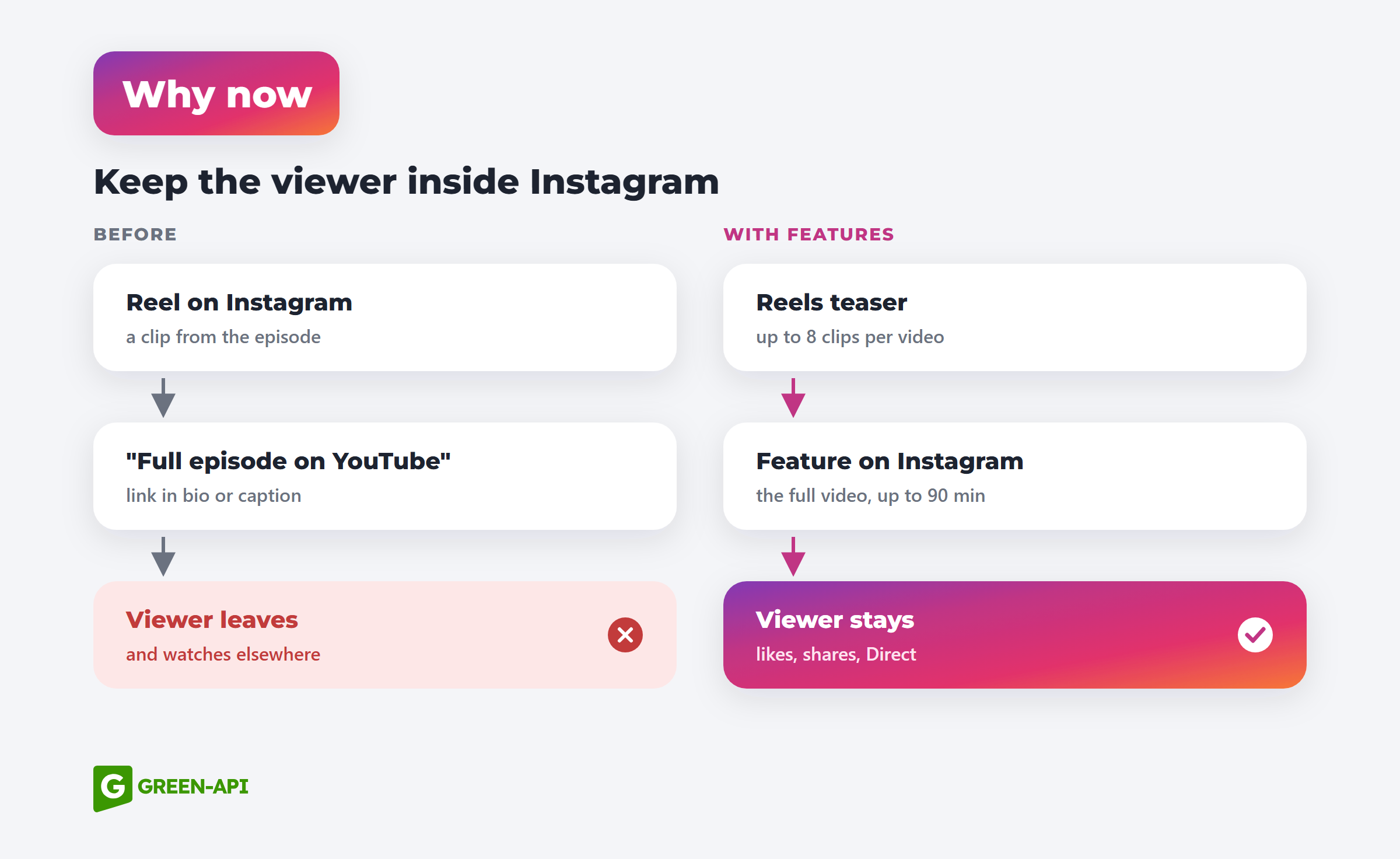
What changed is creator behavior. Podcasters, interviewers, and other long-form creators already cut their episodes into clips for Instagram, then send viewers to YouTube for the full version. Features keeps that viewer inside the app. Lyons explained that “creators are going to be able to link these Reels to their overall feature.” Early testers named by Dexerto include podcast host Emma Grede, beauty creator Monet McMichael, interviewer Preston Rakovsky, and football creator Donald De La Haye.
The TV angle explains the horizontal frame. Lyons said Instagram thinks “the best viewing experience for long-form horizontal content is on a big horizontal screen.” That screen is where YouTube is strongest: in August 2026, it took a record 15.8% of TV viewing time in the US, according to Nielsen.
Instagram vs YouTube vs TikTok: long-form video compared
| Instagram Features | YouTube | TikTok | |
|---|---|---|---|
| Max length | 90 minutes, in test | Up to 12 hours for verified accounts | Up to 60 minutes for some accounts |
| Main format | Horizontal | Horizontal, plus vertical Shorts | Vertical |
| Pay for creators | No revenue share yet | 55% of ad revenue on long videos | Creator Rewards for videos over 1 minute |
| Where people watch | Phone and TV app | Phone and TV | Mostly phone |
YouTube’s advantage is not the length limit. It is a revenue model that creators have relied on for more than a decade.
What is still unclear
Monetization. Instagram has not announced an ad revenue share for Features. “It’s too early to share a long-term monetization model,” a Meta spokesperson told TechCrunch, adding that the company is “exploring ways for creators to earn from brands, fans, and Instagram, including performance-based incentives.” For now, Instagram pays select creators directly: Business Insider and Digiday report offers between $50,000 and $500,000 to a handful of them. Creators can keep their existing brand deals and don’t have to post exclusively on Instagram.
Timing. Instagram plans to expand Features to “tens of thousands” of US creators, according to Dexerto, but it hasn’t said when the format will be available to everyone.
Markets. Features is in testing in Brazil and the US. For Series and Live, Instagram hasn’t published a list of markets, and reports differ. The safe summary is a limited test in select markets.
Creators are interested but cautious. Shine Talent Group surveyed 50 of its creators, and 93% said Instagram would have to change its revenue policies before they post long-form content there. “We’ll post our content there, why not? But I’m not making content for Instagram at this moment in time,” Mustafa Aijaz, a VP at media company SoaR, told Digiday. The industry’s working formula: Instagram is for reach, YouTube is for earning.
What Instagram long-form video means for businesses
The revenue share debate matters less to businesses. A brand doesn’t earn from ad views. It earns when a viewer becomes a customer. If you sell through Instagram, the new formats give you more ways to keep an audience long enough to build trust:
- Features fit product walkthroughs, recorded webinars, and customer interviews. If you already have this content on YouTube or in a webinar archive, test it on Instagram first.
- Series fit tutorials and case studies that a viewer follows episode by episode.
- Every video ends with one action: message us in Direct or on WhatsApp.
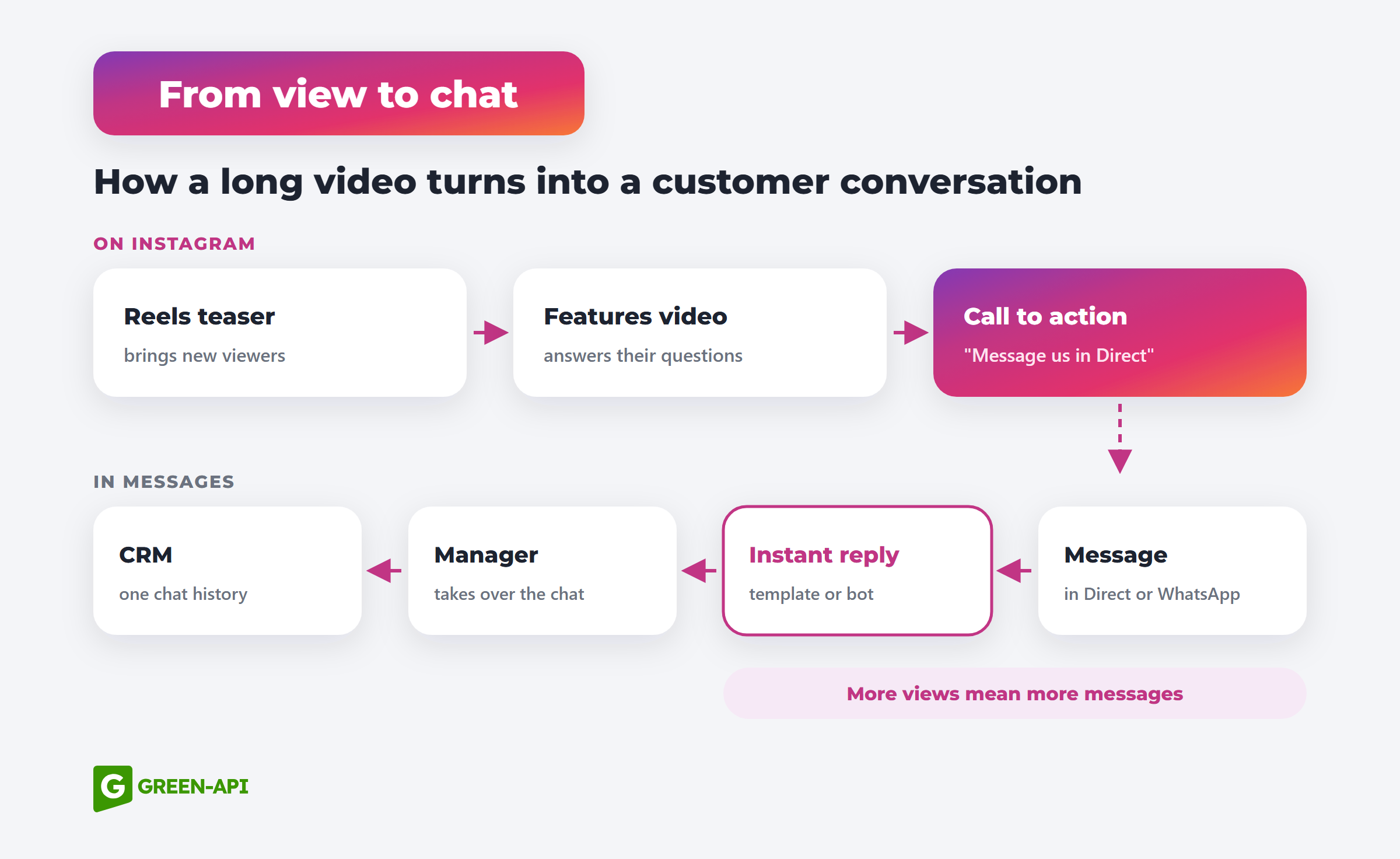
- More views mean more messages. Prepare auto-replies, handoff to a manager, and lead tracking in your CRM before you publish.
Picture an online furniture shop, Shelfly. It publishes a 40-minute assembly and care guide and splits it into five Reels that point to the full video. The Reels bring in new viewers, and the full video answers their questions. The closing call to action prompts some of them to send Direct messages about delivery and prices. If those messages sit unanswered for a day, the shop has earned the interest and still lost the sale.
How not to lose a customer after the video
The conversation starts after the video ends. Plan these steps before the first long video goes live:
- Reply fast. A viewer who just watched 30 minutes of your content is ready to ask. Set up an instant first reply in Direct, even if a person answers later.
- Use reply templates. Most questions repeat: price, delivery, availability, booking. Write short answers for each one.
- Give a second channel. Many customers prefer WhatsApp for orders and delivery updates. Add a WhatsApp chat link to your profile and to every video description.
- Keep one history. Log every conversation in your CRM, so a manager sees what the customer asked before and doesn’t start from zero.
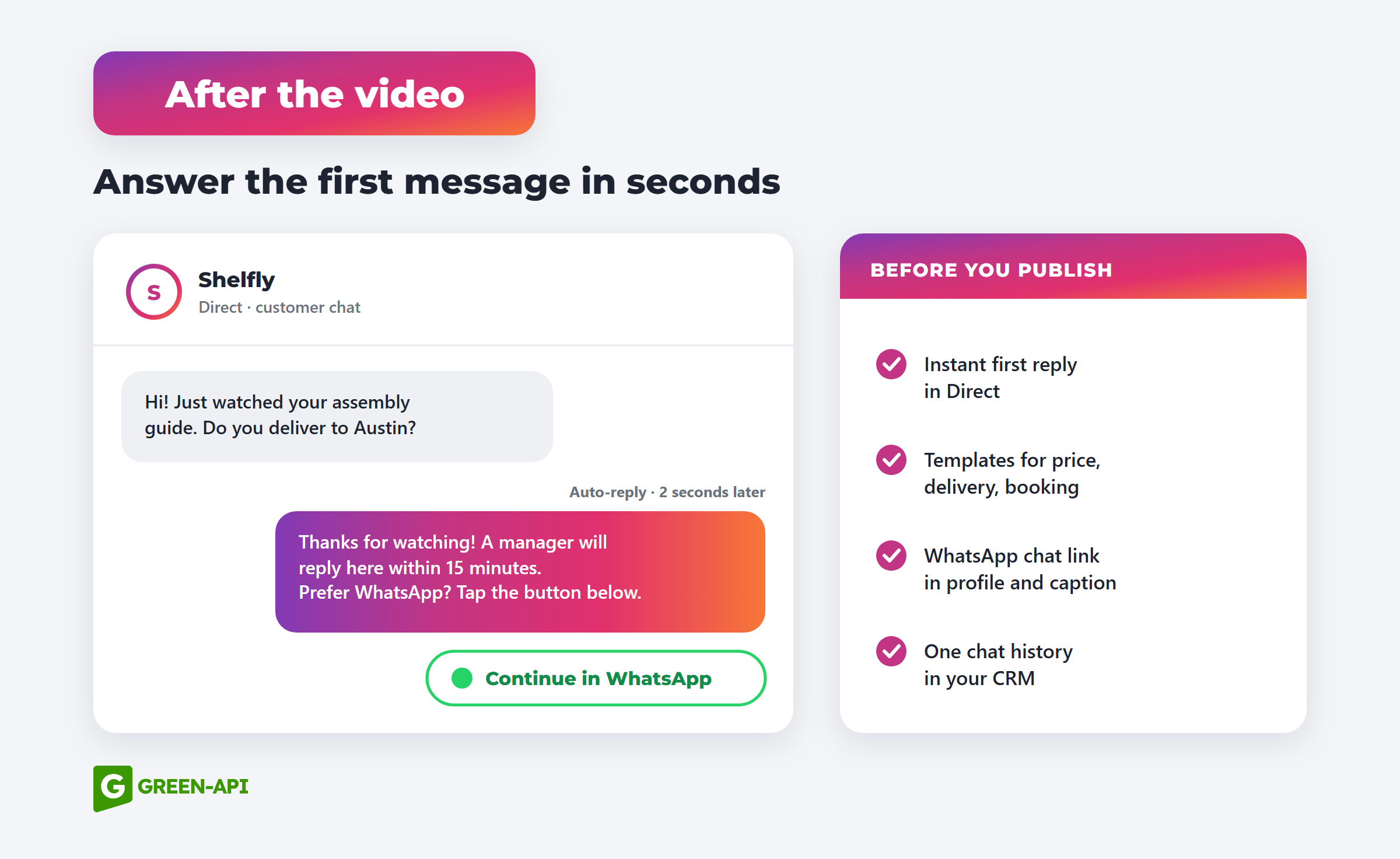
If WhatsApp is part of your sales flow, you can automate replies via API with GREEN-API. Incoming messages arrive in your CRM or bot, routine questions get an automatic answer, and a manager takes over the rest with the full chat history.
The bottom line
Instagram’s long-form test is worth joining if you already produce long content: webinars, interviews, or product guides. Reuse what you have, link Reels to the full video, and watch the numbers. Don’t expect Instagram to pay for it yet. And remember where the sale happens: not in the 90th minute of the video, but in the first message after it.
FAQ
How long can Instagram Features be?
Up to 90 minutes. Features are horizontal videos, unlike vertical Reels.
Who can use Instagram Features now?
Only select creators in a limited test. Instagram tested Features in Brazil and started a US rollout on October 26, 2026. It hasn’t announced a date for a wide launch.
Do creators get paid for Features?
Not through a revenue share. Instagram hasn’t announced one and pays some creators directly. Creators can keep their own brand deals.
What is Instagram Series?
Series lets creators group related Reels into an episodic collection on their profile. It fits tutorials, case studies, and microdramas. The feature is in testing.
How is it different from YouTube?
YouTube allows much longer uploads, shares 55% of ad revenue on long videos with creators, and leads TV viewing in the US. Instagram offers reach and a built-in path from a video to a Direct message, but no revenue share yet.
Turn Instagram and WhatsApp views into conversations: connect WhatsApp to your CRM with GREEN-API.