
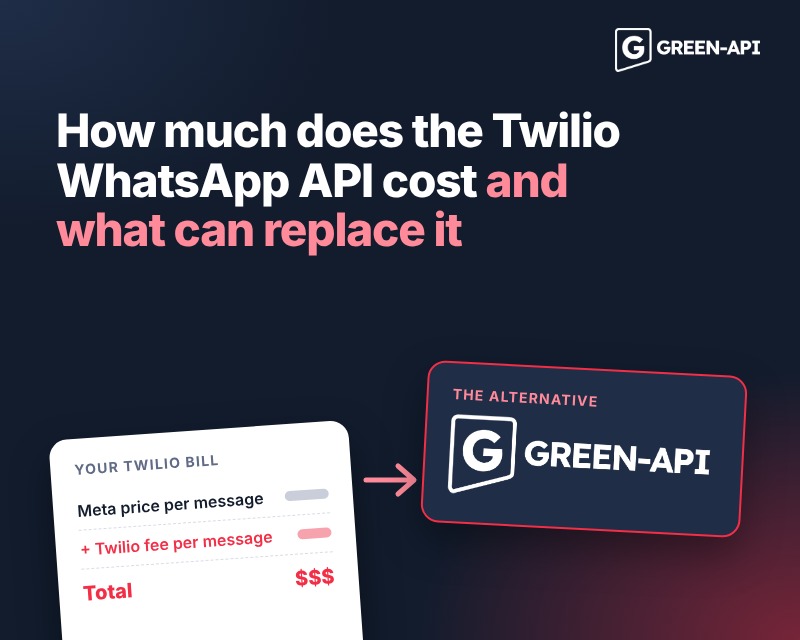
Twilio stands between your business and WhatsApp: it resells access to the official API. So for each message you pay twice: Meta’s price and a Twilio fee of $0.005. When you send few messages, this fee makes the bill much higher. This article shows what a Twilio bill is made of, what 10,000 messages cost, which alternatives to consider, and how to move to another provider.
Table of Contents
How does Twilio charge for WhatsApp messages?
Twilio is an official provider of the WhatsApp Business API, a Business Solution Provider. Your bill has two main parts: Meta’s price for each message and Twilio’s own fee. The Twilio fee is $0.005 per message. It is the same in every country, and you pay it for messages you send and messages you receive. For a message that fails, Twilio charges $0.001.
Meta’s price depends on two things: the country of the recipient and the message category. There are four categories:
- Marketing: offers, promotions and news. This is the most expensive category.
- Utility: order status, delivery updates and payment reminders.
- Authentication: one-time passwords (OTP). An OTP is not a separate product. It is an authentication message with its own price.
- Service: free-form replies inside the 24-hour customer service window. The window opens when a customer writes to you first.
Meta charges for each message, not for each conversation. Since October 1, 2026, utility templates inside the 24-hour window are paid. Service replies are free only for the first 1,000 per phone number each month. After that, Meta charges the utility price for them.
A Twilio bill can have two more lines: a monthly fee for the phone number and support plans that are sold separately. Messages in the Twilio sandbox are also billed at the normal price.
Sources: Twilio WhatsApp pricing and Meta pricing for the WhatsApp Business Platform.
What is the WhatsApp Business API, and what does a provider add?
The WhatsApp Business API is Meta’s interface for sending and receiving business messages at scale. It has no app screen: your software works with it. You can connect in two ways: directly through Meta’s Cloud API, or through a Business Solution Provider (BSP).
A BSP is an official Meta partner that resells access to the API. Twilio, 360dialog, Gupshup, Infobip and Wati are all BSPs. A BSP usually gives you:
- an account and a console to manage your phone numbers;
- one bill for Meta’s fees and its own services;
- tools to create message templates and send them to Meta for approval (a template is a pre-approved message you can send outside the 24-hour window);
- SDKs, webhooks and ready integrations;
- technical support.
A BSP does not change Meta’s rules. Meta sets the price for each message. Meta approves templates, and Meta sets the sending limits. Every BSP works inside these rules. So when you compare providers, you compare their fees, tools and support. You do not get access to a different WhatsApp.
Is Twilio for WhatsApp free?
You can test WhatsApp on Twilio without paying, but only for a short check. There are two options.
The free trial lasts 30 days and needs no credit card. It includes 100 WhatsApp messages, but you can send only Twilio’s ready-made templates, not your own. This is enough to see how the API works, but not to test your own scenario.
The sandbox is a shared test number: +1 415 523 8886. Messages in it are billed at the normal price, and Twilio asks you not to use it for real traffic.
If you need to debug an integration for more than a month or with your own texts, look for a provider with a free plan that does not expire. You will find them in the table of alternatives below.
Twilio vs WhatsApp Cloud API vs a WhatsApp API gateway
You can send WhatsApp messages through an API in three ways. They differ in who you pay and which rules you follow.
Meta’s Cloud API is a direct connection. You pay only Meta’s price for each message. But you build and run everything yourself: hosting, templates, webhooks and support.
A BSP such as Twilio resells the same API. It adds tools, one bill and support. In return, it charges a fee: per message, per month, or both.
A WhatsApp API gateway works differently. It connects a normal WhatsApp or WhatsApp Business account to your software over HTTP. You link the number by scanning a QR code, as in WhatsApp Web. There are no templates to approve and no Meta fee per message: you pay only the gateway’s monthly plan. But a gateway does not use the Business API. A normal account follows the normal WhatsApp rules, and these rules limit bulk and automated messaging. So a number can be blocked for mass messaging, and no provider removes this risk.
| Way to connect | Who you pay | Message templates | Approval | Setup | Best for |
| Meta Cloud API direct | Meta only | Yes | Meta approves each template | Your own code and hosting | Teams with strong developers and high volume |
| BSP such as Twilio | Meta, plus the BSP fee | Yes | Meta approves each template | Sign up in the BSP console | Teams that need tools, one bill and support |
| WhatsApp API gateway | The gateway’s monthly plan | No, normal messages | No template approval | Create an instance and scan a QR code | Developers and small teams who test first or write to their own customers |
If you need approved templates, a verified business profile and high volume, choose the official API. At GREEN-API, this is WABA. For tests and chats with your own customers, the GREEN-API gateway is a good fit.
Best Twilio alternatives for WhatsApp in 2026
Five providers are most often considered instead of Twilio. They differ not only in price, but also in the type of solution. Some give direct access to the API, and your developers build the rest. Others give a shared inbox: one interface where the whole team answers customers from one number. The rest are gateways that connect a normal WhatsApp number over HTTP. The table shows the key facts about each provider.
| Provider | Type | Free option | Message templates | Best for |
| 360dialog | BSP, direct API access | No free plan | Yes | Developers who want Meta’s prices with no markup |
| Gupshup | BSP | No free plan, pay as you go | Yes | Teams in India and Southeast Asia |
| Infobip | BSP, omnichannel platform | Free WhatsApp trial | Yes | Large companies with many channels |
| Wati | BSP with a shared inbox | 7-day trial | Yes | Small teams that answer customers without code |
| GREEN-API | WhatsApp API gateway | Free Developer plan with no time limit | No, normal messages | Developers and small teams who test an idea before paying |
| Twilio (baseline) | BSP, multichannel platform | 30-day trial, 100 WhatsApp messages | Yes | Teams that already use many Twilio channels |
Actual as of October 2026. Check each provider’s pricing page before you sign a contract.
360dialog: direct WhatsApp Business API access
360dialog gives direct access to the WhatsApp Business API. It charges a monthly license for each number, from €49. It passes Meta’s message fees through with no markup. It has no shared inbox or chatbot builder of its own, so you need developers or a partner tool on top.
Gupshup: wide coverage in India
Gupshup is strong in India and Southeast Asia. Its self-serve plan has no monthly fee. Gupshup adds $0.001 to every message, sent or received, on top of Meta’s price. Since January 1, 2026, it also adds 6% to Meta’s marketing fee in some cases: when marketing messages do not go through Meta’s Marketing Messages API. Check the rate card for your case.
Infobip: enterprise omnichannel platform
Infobip is a platform for large businesses. It brings WhatsApp, SMS, email, voice and other channels into one place. Prices are custom and are usually agreed with sales. There is a free WhatsApp trial for testing. Infobip fits large companies that need many channels, contact center tools and strong support contracts.
Wati: shared inbox for small teams
Wati is built for small businesses. On top of the official API, it adds a shared inbox for the whole team, broadcasts and a no-code chatbot builder. Plans are monthly, and prices depend on your region. There is a 7-day trial, but no free plan. Message fees are paid on top of the plan.
GREEN-API: WhatsApp API gateway with a free Developer plan
GREEN-API is a WhatsApp API gateway. You connect a normal WhatsApp number as an instance and send messages with HTTP requests. There are SDKs for Python, Node.js, PHP, Java, Go and other languages. The Developer plan is free: 1 instance, 3 chats and 100 number checks per month. The Business plan costs $12 per month per number, with no fee per message. There are no templates and no Meta approval. The trade-off: a normal account follows normal WhatsApp rules, so a number can be banned for large marketing campaigns. See GREEN-API plans and the free Developer plan.
What do 10,000 WhatsApp messages cost?
We take one case: 10,000 marketing messages per month to each of three countries, India, Nigeria and the United Kingdom. For each country, we add Meta’s message price and the provider fee. Then we compare Twilio with a direct connection to Meta’s Cloud API. Meta’s prices come from its rate card for marketing messages, and Twilio passes them through without changes. All prices were checked in October 2026, after Meta’s rate card update of October 1.
The formula is simple: monthly cost = number of messages × (Meta price + provider fee per message) + monthly fees.
| Country | Meta price per message | Twilio: Meta + $0.005 | Cloud API direct: Meta only | Difference vs Twilio |
| India | $0.0118 | $168 | $118 | −$50 |
| Nigeria | $0.0516 | $566 | $516 | −$50 |
| United Kingdom | $0.0635 | $685 | $635 | −$50 |
| Total, 30,000 messages | — | $1,419 | $1,269 | −$150 |
Send marketing messages only to people who agreed to receive them. Every campaign needs a way to unsubscribe. The rules are in the section “Rules you must follow after you switch”.
Actual as of October 2026. Sources: Meta’s rate cards and Twilio’s WhatsApp price list.
What the table shows:
- The Twilio fee is the same in every country: $50 per 10,000 messages. In India it is about 30% of the bill. In the United Kingdom it is only about 7%.
- Customer replies also cost $0.005 each on Twilio. If 2,000 customers reply in each country, add $30 more.
- A BSP with a flat fee changes the math. With 360dialog, you pay Meta’s price plus a license from €49 per number per month. One number can send to all three countries, so the license costs less than $150 in Twilio fees.
- A WhatsApp API gateway has no Meta fee and no fee per message. The GREEN-API Business plan costs $12 per month per number. But it is a different product: there are no templates, and 10,000 marketing messages from a normal account carry a direct risk of a number ban. For large marketing campaigns, the official API is the safer choice.
Twilio alternatives in India, Indonesia and Nigeria
Twilio works in India, Indonesia and Nigeria: all three are on its WhatsApp price list. But Meta’s prices in these countries differ a lot. When the message price is low, the provider fee becomes the main cost.
- A marketing message costs $0.0118, and utility and authentication messages cost $0.0014. For utility messages and OTPs, the Twilio fee ($0.005) is about 3.5 times Meta’s price. Since January 2026, Meta offers eligible businesses billing in rupees. Indian teams often compare Twilio with local providers, such as Gupshup, which adds $0.001 per message. If you send many OTPs, check whether the higher authentication-international rate applies to you: $0.0304 per message.
- A marketing message costs $0.0411, and utility and authentication messages cost $0.025. This is a high price for the region. Here the provider fee is a small part of the bill, and Meta’s price is the main cost. So the template category matters most: a wrong category can make a simple notification much more expensive.
- A marketing message costs $0.0516, utility and authentication messages cost $0.0067, and authentication-international costs $0.075. Look for a provider that bills in a currency you can pay easily and gives support in your time zone.
Check the price list for your country before you sign a contract. Prices: Meta’s rate card as passed through by Twilio, actual as of October 2026.
How to choose a Twilio alternative for your size of business
Choose by three criteria: volume, team and channels.
- Under 10,000 messages a month, per-message fees add up to a small amount, and the monthly price of the service matters more. At higher volume, the per-message price decides your bill. Conclusion: small senders should compare monthly plans; large senders should compare fees per message.
- Developers can work with any API, so the quality of SDKs and docs matters most. Without developers, you need a ready interface. Conclusion: with developers, choose an API with SDKs and clear docs; without them, choose a service with a shared inbox, such as Wati.
- Some companies need WhatsApp, SMS, email and voice in one place. Others need only WhatsApp. Conclusion: for many channels, an omnichannel provider such as Infobip or Twilio fits; if you need only WhatsApp, do not pay for a platform you will not use.
Large companies with audit and contact center needs usually choose an enterprise provider. Small teams usually start with a free plan, test the idea and then compare the monthly total for their own volume.
How to move from Twilio to GREEN-API
The move does not take long. You can close your Twilio account when all traffic goes through GREEN-API and the last invoice has arrived.
- Create an instance. An instance is the connection of your WhatsApp number to the API. You create it in the GREEN-API console. You get three values for your requests: apiUrl, idInstance and apiTokenInstance.
- Connect a test number and send one message. Scan the QR code from the console with WhatsApp on your phone. Then call GetStateInstance: the state must be authorized. Now send a test message. In GREEN-API, this is one SendMessage request to the HTTP API.
- Prepare your message texts. GREEN-API has no templates: you send normal texts. A number connected to the Twilio Business API can’t also work as a normal WhatsApp account. So, for GREEN-API, teams usually use a different number.
- Run both providers in parallel for a few days. Send a small share of traffic through GREEN-API and compare delivery statuses with your Twilio reports.
- Switch the traffic. When the numbers match, move the rest. Don’t close the old account until you’ve closed the last invoice and report. Message logs stay with the old provider, so export what you need first.
Here is the first message as a curl request. Full details are in the SendMessage method reference.
curl --location '{{apiUrl}}/waInstance{{idInstance}}/sendMessage/{{apiTokenInstance}}' \
--header 'Content-Type: application/json' \
--data '{
"chatId": "919876543210@c.us",
"message": "Hello! Your order #1042 is ready. Reply STOP to unsubscribe."
}'
The same request in Python:
import requests
api_url = "YOUR_API_URL"id_instance = "YOUR_ID_INSTANCE"api_token = "YOUR_API_TOKEN_INSTANCE"
url = f"{api_url}/waInstance{id_instance}/sendMessage/{api_token}"
payload = {
"chatId": "919876543210@c.us",
"message": "Hello! Your order #1042 is ready. Reply STOP to unsubscribe.",
}
response = requests.post(url, json=payload)
print(response.json())  # the response contains idMessage
The chatId is the phone number in international format with @c.us at the end: the country code, with no plus sign.
Note: delivery reports and statistics from Twilio do not move. You will collect them again from zero.
Rules you must follow after you switch
The provider changes, but the rules do not. Write only to people who agreed to receive messages. Add a way to unsubscribe to every campaign. Keep intervals between messages. Warm up a new number slowly. These steps lower the risk of a block. No provider can guarantee that a number stays active.
The WhatsApp Business Messaging Policy lets you write to a customer only when two conditions are met. First, the customer gave you their phone number. Second, you received their consent (opt-in), which confirms they want to receive messages from you. The policy also requires you to respect every request to stop. These rules apply to both the Business API and the WhatsApp Business app.
- Opt-in. Write only to customers who gave consent. Keep a record of when and how you got it.
- Opt-out. Make unsubscribing simple. For example, ask the customer to reply “STOP” to stop receiving messages. Remove people who unsubscribe from your list at once.
- Pause between messages and do not send your whole list in one minute. Aim for the pace of a live operator.
- Warm-up. Start a new number slowly: a few messages a day to customers who reply, then grow the volume step by step.
On the Business API, Meta also sets sending limits. A new business portfolio can start chats with 250 unique customers in 24 hours. The limit can then grow to 2,000, 10,000, 100,000 and unlimited, based on business verification and message quality. More practical tips are in how to lower the risk of a WhatsApp block.
Test it on your own numbers. You can try the whole flow on GREEN-API’s free Developer plan: create an instance in the console, connect a number and send your first SendMessage request. When it works, compare the Business plan with your current Twilio bill. See GREEN-API plans and the free Developer plan.
Frequently asked questions
What is a free alternative to Twilio?
You cannot send unlimited WhatsApp messages for free. On the official API, Meta charges for template messages with any provider. Only the start can be free. Twilio gives a 30-day trial with 100 WhatsApp messages. Infobip and Wati also have trials with a time limit. A free plan is different: it does not end. The GREEN-API Developer plan costs $0 per month with no time limit. It includes 1 instance, 3 chats and 100 number checks per month. That is enough to test an idea, build a bot prototype or debug webhooks, but not enough for real customer traffic.
Is Twilio allowed in India?
Yes. Twilio sells WhatsApp messaging in India, and India is on its WhatsApp price list. The real questions are rules and cost. Meta’s consent rules work the same way with any provider. In India, Meta’s prices are low: $0.0118 for a marketing message and $0.0014 for a utility or authentication message. So the Twilio fee of $0.005 per message becomes a large part of the bill. For utility messages and OTPs, it is about 3.5 times Meta’s price. This is why many Indian teams compare Twilio with local providers such as Gupshup.
Who are Twilio’s largest competitors?
For WhatsApp, you will most often meet Infobip, Gupshup, 360dialog, Wati and Bird. Infobip is an enterprise platform for many channels. Gupshup is strong in India and Southeast Asia. 360dialog gives direct API access with a monthly license per number. Wati gives small teams a shared inbox and a chatbot builder. Bird, formerly MessageBird, is a messaging platform that adds its own fees to Meta’s prices. A WhatsApp API gateway such as GREEN-API is a different class of solution: it connects a normal WhatsApp number over HTTP, not through a BSP.
How can I send 10,000 messages on WhatsApp?
You cannot send 10,000 messages from the WhatsApp app: you need an API. Success depends on two things: the sending limit on your account and the consent of your contacts. On the Business API, a new account can start chats with 250 customers a day. After business verification and with good message quality, the limit grows to 2,000 and more. Write only to people who agreed to receive messages, and give every message a way to unsubscribe. Keep intervals and warm up a new number over several days. With an API, you build a queue, send in batches and see the delivery status of each message. This lowers the risk of a block, but no provider can guarantee that a number stays active.
Can I migrate from Twilio without downtime?
Yes, if you run both providers in parallel for a few days. Open the new account, connect a test number and send one message. If you move to another BSP, Meta can migrate your number together with its approved high-quality templates. The display name, quality rating and sending limit stay with the number. If you move to a gateway, you write normal message texts instead of templates. Then send a small share of traffic through the new provider and compare delivery reports. When the numbers match, switch the rest. Keep the old account open until the last invoice and report are closed.
Is there anything better than Twilio?
It depends on your task. Twilio fits well if you need many channels, a large support contract and one invoice. It fits poorly if WhatsApp is your only channel and your volume is small. Then you pay $0.005 for every message you send and receive, for a platform you do not fully use. A WhatsApp API gateway with SDKs and a free Developer plan lets a small team test an idea before paying. A large company with audit and contact center needs fits an enterprise provider. Before you decide, calculate the monthly total for your own volume with the table in the pricing section.